
Spring Valley Previous Residents Timeline
Past residents leave different kinds of evidence in different eras. The modern parcel record is the starting point, but Rockland’s historical shelves can carry the trail much farther back. The table separates ownership, household, and structure sources so that a result is not asked to prove more than it can. For example, a deed records a transfer, an assessment roll records a taxpayer or owner context, and a directory or census may identify people associated with an address.
| Source | Years it covers | Where held | What it shows |
|---|---|---|---|
| Rockland deed holdings and index | 1798-present holdings; archive originals 1798-1907 | County Clerk, Cott eSearch, and County Archives | Grantors, grantees, legal descriptions, recording dates, and transfer clues |
| Ramapo tax and assessment rolls | 1855-1964 archive window | County Archives; current Ramapo and village rolls | Owner or taxpayer context, class, assessment, and parcel continuity |
| Cross Reference Directories | 1978-1999 | New City Library Rockland Room | Historical address-to-occupant or business leads |
| Rockland telephone books | 1910-1998 | New City Library Rockland Room | Name, address, and telephone context |
| Federal and New York census material | Federal public through 1950; New York runs 1830-1925 | Archives, GSRC, and library collections | Household snapshots, relationships, ages, and places |
| Spring Valley Sanborn map | August 1918, seven sheets | Library of Congress | Building footprint, use, materials, and street layout |
Start with the era closest to the address question. Recent prior residents may need the parcel and deed trail first. An older Spring Valley address may need a map, tax roll, or census before a modern street name makes sense. Note: Telephone and reverse-directory listings are leads, not proof that every listed person owned or occupied a property.
Spring Valley Previous Residents Parcel Start
The Town of Ramapo Property Record Online System, or PROS, is the current parcel starting point for a Spring Valley address. Search by address, then capture the Tax Map or SBL identifier, property location, owner result, and any available assessment information. SBL means section-block-lot, the parcel key used across tax and map records. Use the exact returned address and municipality to avoid a partial text match. The system also offers owner-name and Street Finder searches, but an owner match is not the same as an occupant match.
Next, keep the legal description with the SBL. A legal description identifies the parcel through lot, block, subdivision, or metes-and-bounds wording. It is the better key when a street name changes, a house number is absent, or one older parcel becomes several newer ones. The current owner, street address, and parcel identifier form a starting set, not a conclusion about who lived in the Spring Valley house before.
Parcel check. Cott warns that section-block-lot information in its online system is unverified, so confirm the SBL with the town or village assessor before relying on it.
Spring Valley Previous Residents Deed Trail
The deed chain answers the ownership side of a previous-residents question. Start at the current parcel, then use the current owner as a grantee in the Rockland County Clerk land index. A grantee is the person or entity receiving property. The purchase deed should identify the seller, called the grantor, and provide a recording reference and legal description. Search that seller as a grantee to locate the deed by which the seller acquired the parcel. Repeat the sequence, checking the same legal description as the names change.
- Search the Spring Valley address in Ramapo PROS and record the current parcel SBL and legal description.
- Use the current owner as grantee in the County Clerk’s land-record search and confirm the purchase deed.
- Record the seller or grantor, recording date, instrument or book-and-page reference, and the legal description.
- Search the seller as a prior grantee, then compare the earlier deed to the same parcel description.
- Continue backward until the index or image trail ends, then ask the Clerk search room or County Archives for the earlier record path.
- Grantor
- The person, estate, trustee, or entity transferring an interest in a deed.
- Grantee
- The person, estate, trustee, or entity receiving the interest named in a deed.
- Chain of title
- The ordered sequence of transfers affecting the same parcel, checked by names and legal descriptions.
- Legal description
- The parcel wording in a deed or map, often more stable than a street address across historic records.
A deed may include an estate representative, spouse, trustee, corporation, easement, or subdivision reference. Those are record-party roles, not automatic proof of residence. Search variant spellings and preserve the parcel key at every step.
Spring Valley Deed Index Access
Rockland County Clerk Cott eSearch permits guest viewing without a charge. Registered users can print at $0.50 per page. The Clerk’s land-record holdings reach from 1798 to the present, although the exact online index or image cutoff for each series is not posted. Treat an empty online result as an access question, not proof that the Spring Valley deed does not exist. Original deeds from 1798-1907 and other older land material have an archive route.
The Cott eSearch access screen is the online starting surface for Spring Valley previous residents research through the County Clerk’s deed index.
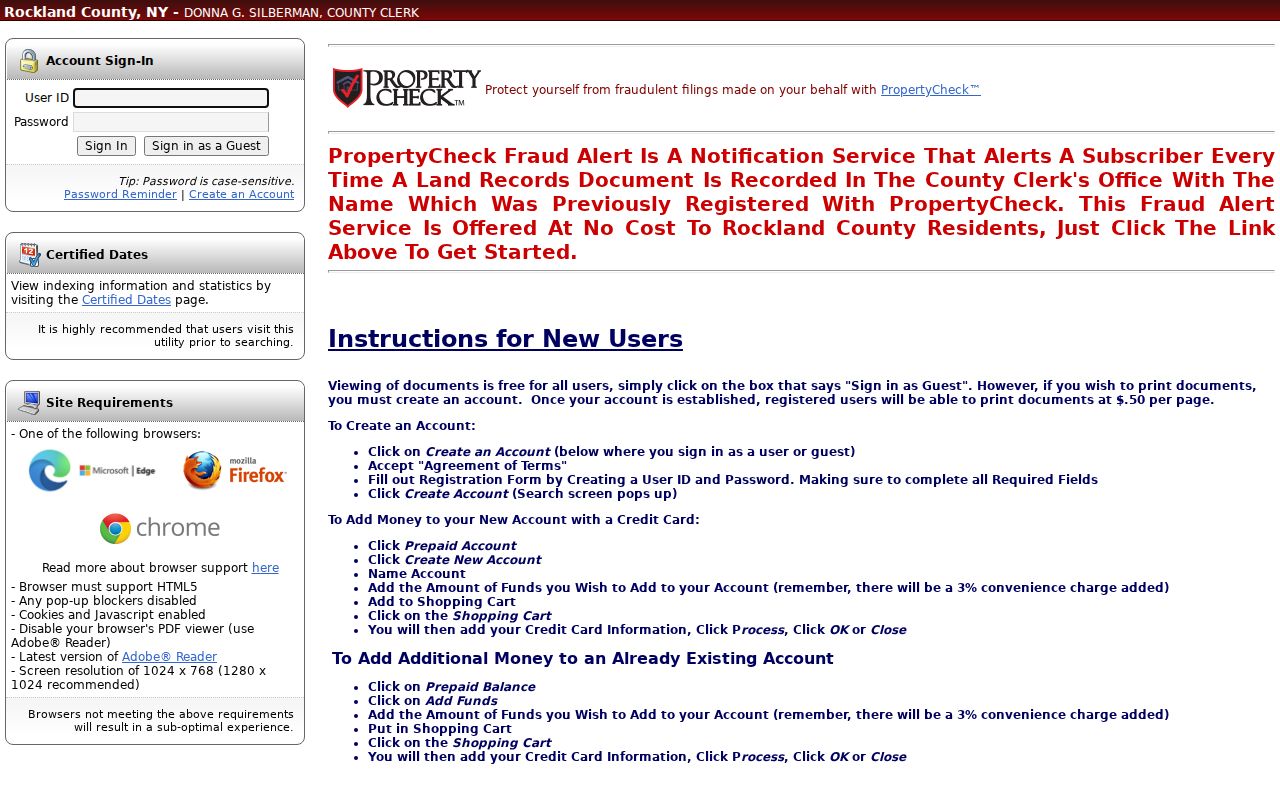
Guest viewing can establish whether a deed lead is present, while printing, certified copies, and archive material follow their own Clerk procedures.
The county also documents an in-person Information Desk in the Clerk search room, online PayIt requests, and mail requests with a self-addressed stamped envelope. An uncertified request is $5 for the search plus $0.50 per page. A certified request is $5 plus $1.25 per page. Those channels are useful when the online index is incomplete, a printed copy is required, or a clerk must help locate an older reference.
Spring Valley Address Label Trap
An old address can fail because the place label changed, not because the property disappeared. A Census Bureau historical table records that part of Clarkstown was annexed to Spring Valley in 1945. Historic census, tax, or directory material may therefore identify the same area as Clarkstown, “Spring Valley (part),” Ramapo, or a modern village label. Keep the source’s original place wording and search each relevant label before rejecting a person or parcel result.
No official source reviewed documented a Spring Valley-wide street-renumbering project or a definitive renamed-street year. Do not invent one. Instead, use the SBL and legal description, inspect the 1876 and 1891 atlas or the map index when available, and search the old street without a suffix. The County Clerk’s map index and historic plats can connect an old lot or subdivision name to a newer address. This is why the legal description is the essential bridge in a Spring Valley house-history search.
Note: A matching street name alone is weak evidence when historic municipal labels, parcel boundaries, or house-number systems may have changed.
Spring Valley Previous Residents Household Trail
Ownership is only one part of who lived here before. The Rockland Room’s Cross Reference Directories cover 1978-1999 and can provide an address-order household or business lead. County telephone books cover 1910-1998. Pair either source with the nearest public federal census, available through 1950, or the relevant New York census run. The census supplies household relationships, ages, birthplaces, and occupations that an address listing may leave out. Compare the source year, exact street form, place label, and nearby household names.
A practical flow is: address or legal description, then parcel, then deed owner, then directory or telephone entry, then nearest census. Add a newspaper, obituary, or probate source only when the earlier links line up. The Spring Valley Directory Book describes the verified Rockland Room collections and how to read them without assuming an unverified Spring Valley publisher or run.
A listed owner may live elsewhere. A listed phone may be a business contact. A census household is a time-specific snapshot. Keep those distinctions in the notes, especially when a parcel was rented, held in a trust, or owned by an estate.
Spring Valley House Map Test
The Library of Congress Spring Valley Sanborn map has seven public-domain sheets dated August 1918. It can show whether a building footprint, street layout, materials, stories, or use existed in the period under review. It cannot name the people who lived there. Use it to test the structure and address setting, then tie that result to the deed chain, directory, census, or a newspaper notice.
The map is especially useful when an older deed gives a lot or boundary description rather than a present-day street number. Compare the map’s surrounding structures and street configuration with the legal description and historical atlas material. If the parcel cannot be reconciled, return to the Clerk search room or County Archives instead of forcing a modern address onto an old record.
Spring Valley Previous Residents Archive Fallback
No official Spring Valley house-history guide was found. The documented fallback chain is the New City Library Rockland Room, the Genealogical Society of Rockland County, the County Clerk search room, and the Rockland County Archives. Each holds a different layer. Ask the Rockland Room about telephone books, Cross Reference Directories, newspapers, maps, and a shelf check. Ask GSRC about census, cemetery, church, funeral-home, and related indexed material. Ask the Clerk about land-record references and the Archives about older deeds, tax rolls, maps, and census books.
Rockland’s archival holdings include deeds from 1798-1907, mortgages from 1798-1931, Ramapo assessment rolls from 1855-1964, and census books from 1855-1925. A narrow request should give the historic and modern location labels, street or legal description, approximate date, and the record type wanted. That makes the search reproducible and avoids asking an office to create a person list that it does not maintain.
Spring Valley Previous Residents Story Endpoints
Newspapers, probate, and cemetery records can close a long past-residents trail. The Rockland Room holds newspaper microfilm across several county titles, and LARC Digital Collections provide selected digital runs. Archive and Surrogate materials can identify executors, heirs, estate property, or death-related records. Use those sources to explain a transfer, a household change, or a new place label after the parcel and time frame are already established.
Keep the research purpose historical and personal. A public record may be old, incomplete, or wrong, and a living person’s current location is not established by an old address. For a current address chain, the Spring Valley Street Directory follows the address-keyed public sources without turning a historic lead into a present household claim.
Lawful use. Use Spring Valley previous-resident records for house history, family history, estate work, and personal research, never to stalk, harass, or harm any person.